Separate rooms, separate keys.
Every tool runs in its own space with only the access its job needs. If one breaks, the others keep running — one problem stays one problem.
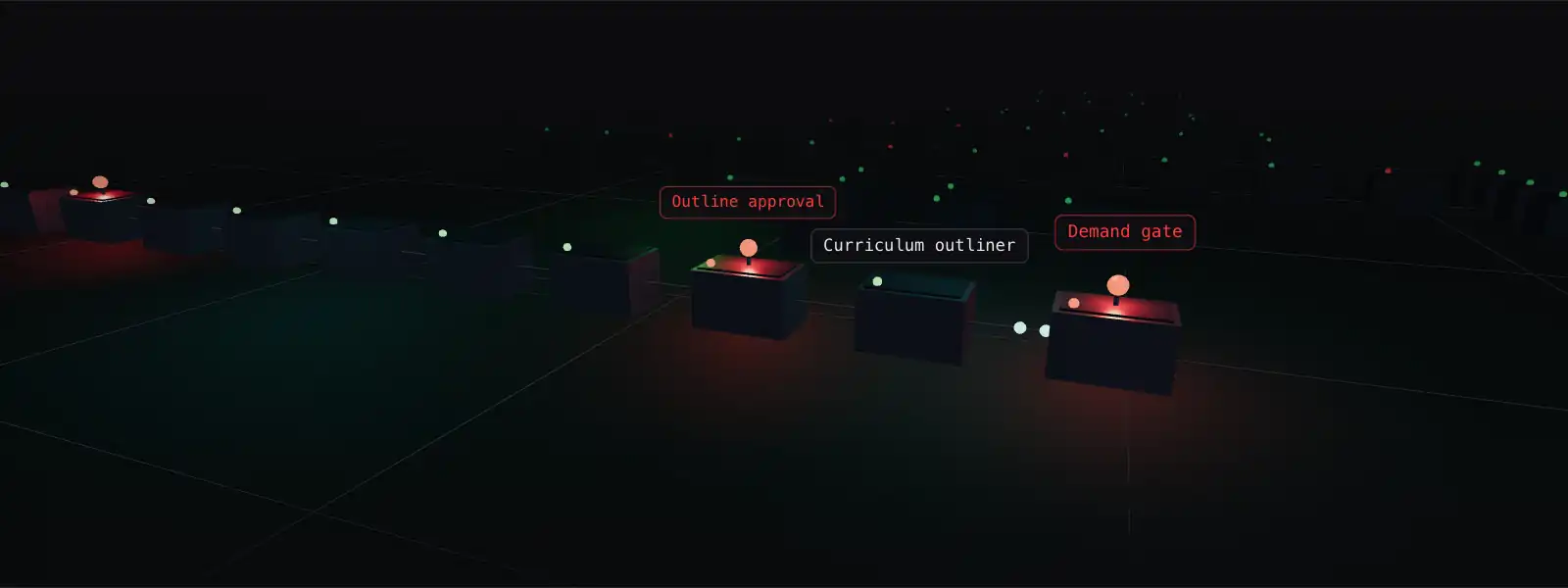
A 3D map of 7 real pipelines — Course Builder, YouTube Factory, Website Dev, Instagram Growth, Competitor Watch, Deep Research, Research Wiki — totalling 50 stations and 16 human gates. Every lane, station, and gate is listed with its description in the pipeline directory section below.
Live map, rendered from real data
Skills, agents, and workflows assembled into pipelines that ship content, courses, and client work. Green means the line is running. Red means a human signs off.
On this floor, red means a human acts — this button is yours.
How the floor works
Every machine on the floor is a tool I built and run daily: a skill does one job well, agents chain skills with judgment, and workflows run whole pipelines end to end — the same lines producing the videos, courses, and client work this site points at.
The map above isn't an illustration. It renders from the same files the pipeline runner reads, through one curation pass so the names read in plain English. When the floor changes, the map changes. One of the lanes up there — Website Dev — is the pipeline that built this page.
Course judge
rendered from PIPELINES.md — the same file the pipeline runner reads
topology real · names rewritten for a public audience · derived 2026-07-06
Built in, not bolted on
Approval gates, blast-radius limits, and audit trails run in every lane by construction. The red lamps on the map are real stops: nothing publishes, prices, or deploys until a human says so.
Every tool runs in its own space with only the access its job needs. If one breaks, the others keep running — one problem stays one problem.
The gates on the floor are real: drafts wait for approval, publishing defaults to dry-run, and deploys wait for a word. The tools draft; a person decides.
Each run writes its result and the operator's next step to plain files on disk — documentation you can read, not a dashboard you have to trust.
The floor, in text
The same map, readable without a pointer: 7 pipelines, 50 stations, 16 human gates — a curated public subset of the factory's pipeline map, topology as declared.
curated public subset — private client and persona lanes are excluded, never disguised · derived from PIPELINES.md + AUTOMATION.json on 2026-07-06
Workshop notes
The blog is the factory's paper trail — what shipped, what broke, and what it costs to run.
AI Agents That Improve Their Own Instructions: The Karpathy Loop for Skill Files
How agents can rewrite their own skill files, test the result, and keep only what performs better.
Why Your Vibe-Coded App Breaks — and What Actually Works for Non-Technical Builders
AI-generated code fails in ways you can’t fix by describing the fix. What holds up instead.
Build Your First AI Agent With No Code
A plain-English starting point: what an agent is, what to hand it first, and where the limits are.
Why a community instead of a sales call? Because the runbooks, the build logs, and the pipelines you just toured are posted there as they ship. Free to join, no card required.
Want the operator, not the room? info@onemanops.com